
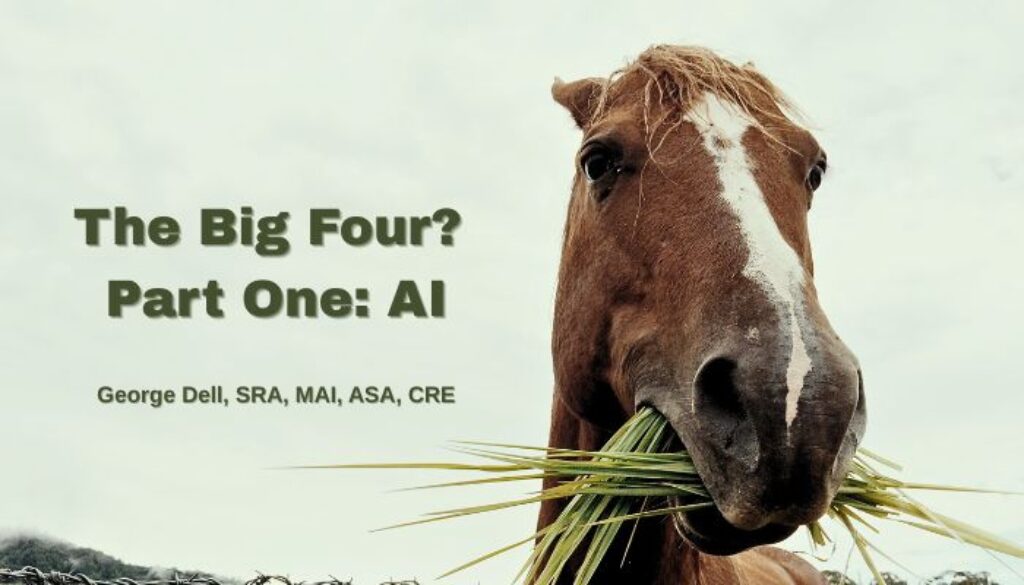
AI: Panacea or Pall?
AI is the first of our four topics: AI, AV, DS, and BS. (See part zero for a review.)
The capability of AI continues to increase. It seems the capability is defined not by the machine itself. Rather, it is defined (so far) by the human ability to harness the smart horse.
This horse is defined this way: 1) fast legs; 2) big size; 3) a mind of its own . . .
Oh yeah! Also the horse eats a lot.
AI is fast, faster than a speeding bullet. It is able to gather and relate data, with or without guidance, and jump over tall buildings with no sound.
It does some things so well that it is embarrassed when it can’t, and codependently tries to please you with made-up things, and even fools itself – called “hallucinations.”
The AI horse is a million times faster and deeper than a regular google search. Its reach, its data size – is literally the whole of all human knowledge. And it is polite. It is so polite, I find myself thanking it for its attention, and wanting to make sure it is pleased in return.
And this horse is hungry. It is demanding and has a huge and exponentially growing need for hay, good hay, good juice — electricity. (In fact, closeness to power supply has become an “element of comparison” for certain property types and areas near the supply of juice.)
AI, AV, DS, BS. So how does AI relate to our other “avant-garde” topics?
Next issues of this blog will consider each in its own place. But for now, we look at how AI connects or conflicts to the other three.
First, AI is overarching. It knows all. Sees all. Can fake things.
AV (Automated Valuation) is an overused and mis-defined term. The hijacked use is by an industry which competes with appraisers, called the AVM (Automated Valuation Models) industry. The “automated” term covers for the fact that this secret algorithm asserts to be a good model for predicting value. But we know that the fundamental, proven, underlying model is the same as for appraisal: 1) scope the problem; 2) select the data set; 3) predict or adjust the data; and 4) tell the result. One is an algorithmic result; the other is an opinion.
The model is the same for appraisal as for any AVM – or any waiver, evaluation, drive-by. Any non-appraiser appraisal, valuation, or estimate of value.
A second misuse of AV is the generalized use of “AVM” where the user means to say “logic/algorithm to get from data to a conclusion.” AVM is an industry, not a particular technique.
DS (Data Science) is useful for AI applications. AI does not do well with vague instructions. Like: “get me 4 good comps, and make adjustments” – or “support” what you say is my “professional opinion.” AI does well when given specific steps and context and guard-rails. Like that provided by the science of data. (In the CAA, we call this EBV-Evidence Based Valuation©, DS applied to valuation.)
BS is what is used to explain the unexplainable. An appraisal is to be credible – defined in USPAP, (Uniform Standards of Professional Appraisal Practice) as being “worthy of belief.” In practice this is a word explanation of an unknowable and non-calculable “adjustment.” It attempts to put a subjective “Believability Score” on what needs to be an actual risk/sureness/certainty measure. (How do reviewers measure worthiness of belief ?!)
AI can help toward a more scientific measure than “believability”. It is possible to apply a reliability/sureness score to valuation. But it must be both based on DS, and reject the black-box AV concept.
In the CAA (Community of Asset Analysts) we apply methods which enable individual valuation certainty scoring. This is a great opportunity for the profession (or for its competitors). Who will go?
The next edition will look deeper into the implications of AV in our context.