
Appraisal is the process, not the report. While the quasi-governmental agencies (the Government Sponsored Entities FannieMae and FreddieMac) are the dominating (monopolistic?) entities, they cannot and should not dictate how analysis and value opinion is done.
We start this multi-part series by looking at how we got here – our legacy. This includes our history, our data, our standards, and what we are taught. And especially a belief structure on how things should be!
Our “professional” belief structure can be divided into two groups: one is non-residential (“commercial”), dominated historically by the Appraisal Institute (AI). The other is residential, dominated by said GSEs.
The AI (Appraisal Institute), in turn, tends to be dominated by MAIs, who hold the well-recognized designation. Due to this political overcast, the AI has continually been accused of not paying attention to its residential appraisers (SRAs), and residential issues in general.
The GSEs have dominated the manner in which residential appraisals are done. The URAR (Uniform Residential Appraisal Report) and related rectangular-paper-oriented forms, are report forms. However, FannieMae has long set extensive guidelines on how appraisers are to develop appraisals.
Many of these guidelines, routines, and practices were established decades ago. Some of these guidelines specifically controlled how ‘adjustments’ were to be made. An example was the limit of 10% on individual adjustments, and 25% on overall (gross) adjustments.
Even where such guidelines and requirements have been removed (such as those which supported historical/official racial ‘red-lining’ of certain neighborhoods) – their legacy remains and is still part of the lore of how an appraiser can avoid being challenged on “choice of comps,” or size of adjustments.
Long after guidelines and rules are removed, the related personal training and even groupthink continues to set the informal rules of behavior. The “master-apprentice” model worked in the past, for good reason: personal experience was absolutely needed in a world of sparse, incomplete, and difficult to obtain information. This trainer-trainee paradigm appears to “officially” be on its way out.
In essence, often “who you know” was more important than “what you know.” This continues to be true in much of the less-developed world, and nations where widespread corruption is the norm.
We start here — to focus on the past which got us here: the habits, the ‘non-existence’ of the science of data, the multi-layered regulations, and the power of the dominant users of appraisals.
Even the dominant standards (USPAP) recognized the subjectivity and personal nature of the appraisal thinking process. It was necessary. The guiding rule for the appraiser is to be “worthy of belief” (credibility) – not reliability, not usability, not understandability. Believability.
There was no way to ‘prove’ accuracy or objectivity, or bias, whether analytical bias, or personal bias.
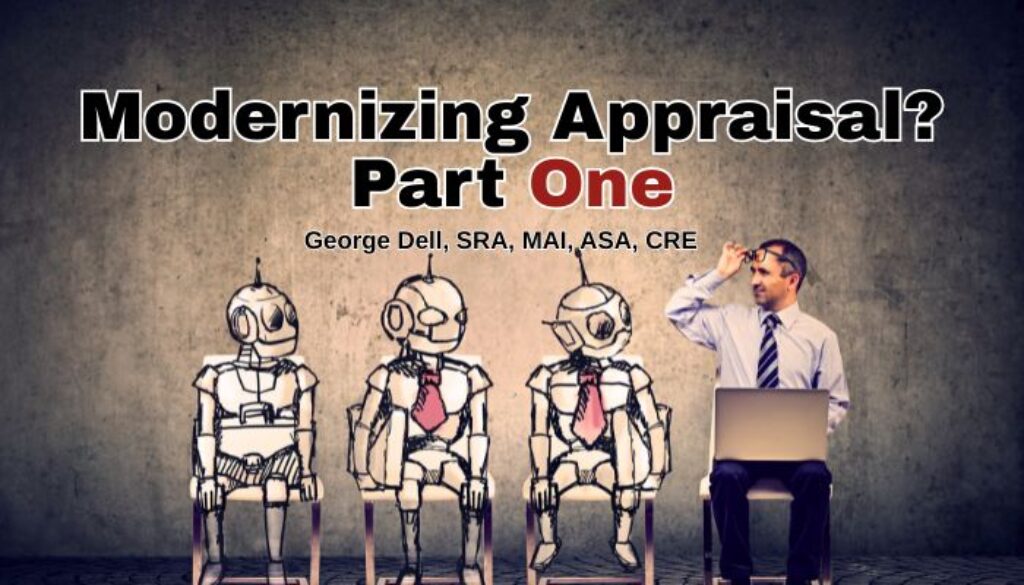
It appears that any replacement/improvement of the appraisal process must account for several factors: 1) physical technologies, including construction, and land-use changes; and, 2) process technologies. These includes databases, computation analytics, expert-computation interface and visualization, and the proper use of artificial intelligence.
The next in this series considers the unique analytic challenges of appraisal, comparing historical solutions to today’s “modernized” approaches.